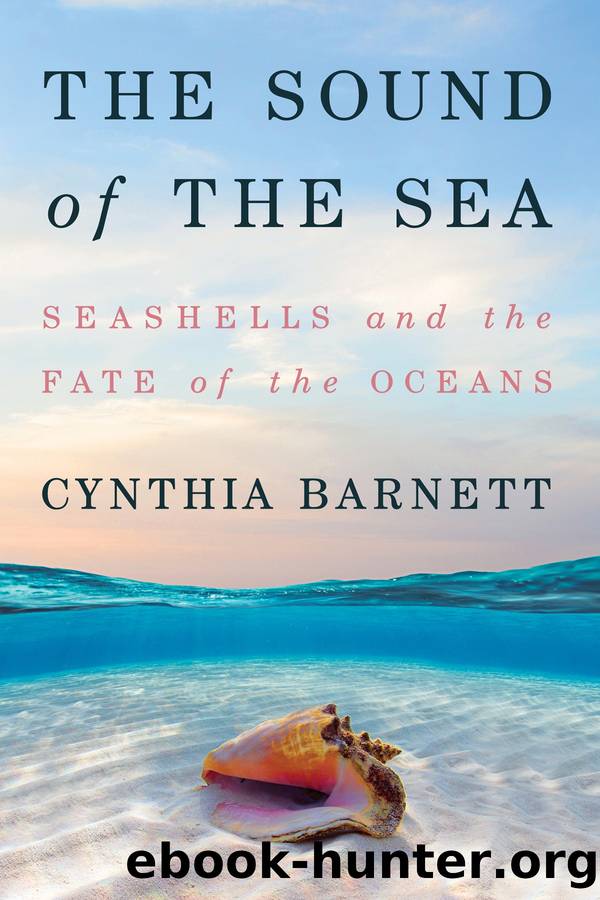
The Sound of the Sea: Seashells and the Fate of the Oceans by Cynthia Barnett
Author:Cynthia Barnett [Barnett, Cynthia]
Language: eng
Format: epub
ISBN: 9780393651447
Google: 0AEDEAAAQBAJ
Amazon: 0393651444
Published: 2021-07-06T00:00:00+00:00
Strobel gushed over shell-calcified soils prime for Sea Island Cotton; the ideal climate; and the ready market to Pensacola, Mobile, and other points around the Gulf. He promised would-be settlers vibrant farms, healthy living, and bountiful nature: A seine net could pull more than one hundred sheepshead in a single haul. The oysters and clams were among the biggest heâd seen. The deer and wild ducks âmay be had with very little trouble.â
Strobel soon lost his position with the company for killing a man in a duel. His Sanibel dreams would come true, if not in his time. Sixty settlers who bought into the Florida Peninsular Land Co. abandoned their farms just two years later to escape the surrounding battles of the Seminole Wars. Census takers made no mention of Sanibel in 1840, 1850, or 1860. In 1870 the islandâs census taker counted only himself and his son.
Two flashing beacons finally drew investment in Sanibel: the iron tower lighthouse that still stands on the southeastern tip of the island, and the first tarpon caught on rod and reel, hauled in by a New York sportsman from what is now Tarpon Bay on the islandâs north side.
Sanibel still rose with hulking Calusa mounds when the first archaeologists visited in the late 1800s. Before the turn of the century, homesteaders were using the mounds as rock quarries, hauling the shell away to mix tabby building materials, erect structures, and lay shell roads across sand. The homesteaders farmed in the calcified soils as Strobel had imagined, growing plump tomatoes that were famous in northeastern markets by the turn of the century. Many farmers doubled as fishing guides and innkeepers to nurture the burgeoning tourism industry. Tourism would prove both more lasting and more lucrative than tomatoes; only the very wealthiest Americans could make their way to the island. Women walked the beach in long skirts, parasols in one hand and shell baskets in the other, their hands covered in gloves to protect them from the sun and mosquitoes.
One afternoon as locals battled a brushfire near the seashore, three anonymous visitors wading near the lighthouse ran up to help. They turned out to be Henry Ford, Harvey Firestone, and Thomas Edison, who shared a love of seashells with his wife, Mina. Edisonâs infamous industrial research labs in West Orange, New Jersey, were crammed with countless thousands of articles mechanical and natural, from gears to gastropods. But the great inventorâs gravestone in New Jersey features only one iconic image. It is not a light bulb or a phonograph, but a large, scalloped shell.
Download
This site does not store any files on its server. We only index and link to content provided by other sites. Please contact the content providers to delete copyright contents if any and email us, we'll remove relevant links or contents immediately.
Sapiens: A Brief History of Humankind by Yuval Noah Harari(14389)
The Tidewater Tales by John Barth(12659)
Mastermind: How to Think Like Sherlock Holmes by Maria Konnikova(7343)
The Thirst by Nesbo Jo(6944)
Do No Harm Stories of Life, Death and Brain Surgery by Henry Marsh(6941)
Why We Sleep: Unlocking the Power of Sleep and Dreams by Matthew Walker(6722)
Life 3.0: Being Human in the Age of Artificial Intelligence by Tegmark Max(5558)
Sapiens by Yuval Noah Harari(5370)
The Body: A Guide for Occupants by Bill Bryson(5096)
The Longevity Diet by Valter Longo(5064)
The Rules Do Not Apply by Ariel Levy(4969)
The Immortal Life of Henrietta Lacks by Rebecca Skloot(4587)
Animal Frequency by Melissa Alvarez(4470)
Why We Sleep by Matthew Walker(4445)
The Hacking of the American Mind by Robert H. Lustig(4381)
Yoga Anatomy by Kaminoff Leslie(4363)
All Creatures Great and Small by James Herriot(4320)
Double Down (Diary of a Wimpy Kid Book 11) by Jeff Kinney(4268)
Embedded Programming with Modern C++ Cookbook by Igor Viarheichyk(4179)
